by Oko Owoicho
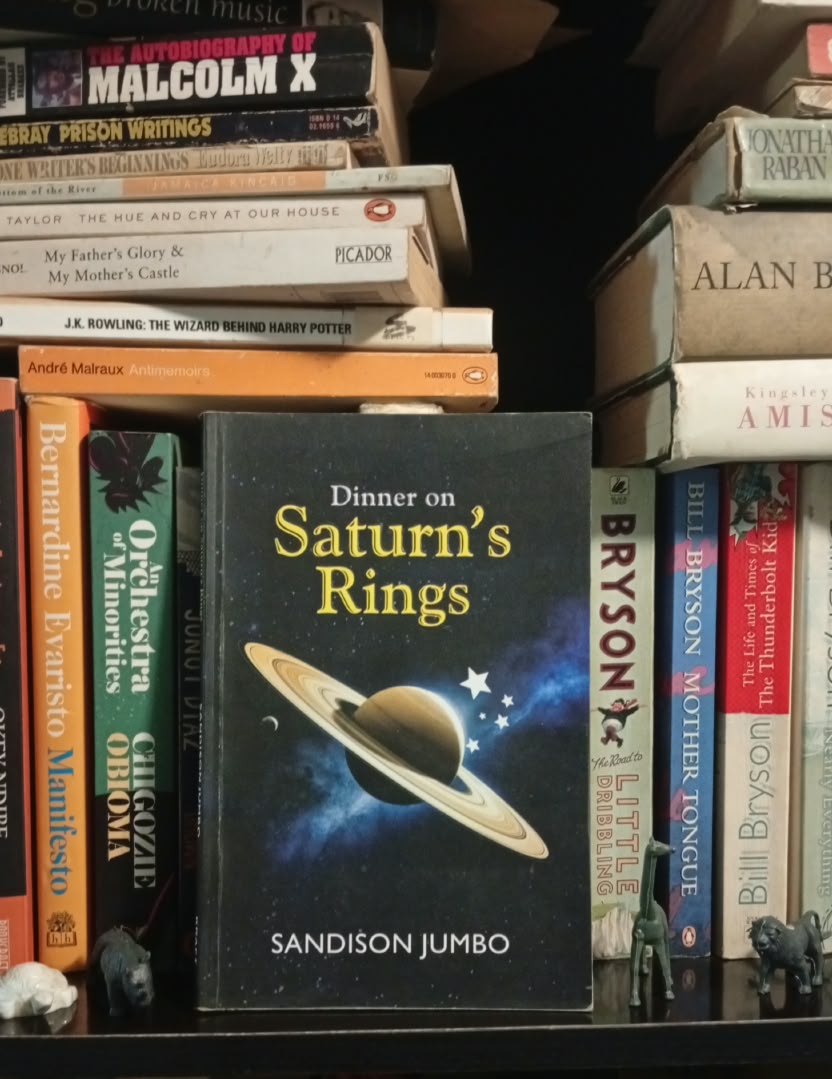
Poetry shows its completeness through two major structures: pleasuring itself through language and speaking to the world. The first act is the narcissism of the genre, which makes its language delicate and its power ethereal. There is nothing more powerful than the self-awareness of this art form; it also does not fail to speak to the world—which makes it resolve the question of form and content as two inseparable identities of any good art. It is the polyamory of language, as both a subject in itself and a tool for change, which shows the wildness and width of Sandison Jumbo’s Dinner on Saturn’s Rings.
Dinner on Saturn’s Rings, an eighty-six-page collection of poems, is divided into five sections: “Life: Journey & Philosophy,” “Belief, Faith & Ritual,” “Memories,” “Nature and the Physical World,” and “Love and Laughter.” The first poem, “In Thrall,” is both a self-confession for the poet—a way to justify his untamed creativity, for, as Oscar Wilde said, “It is the confession, not the priest, that gives us absolution”—and a mental preparation for the reader that the collection would take us through different realms. And indeed, we went through spaces where gods speak and death is addressed. “In Thrall” shows the journey of an individual who “scooped plasma from the sun/ To cook meals and heat my bath,/Moved Mount Everest just for fun;/None can ever walk my exact path” (12).
More than self-glorification for overcoming ordeals, the poet-persona seems instead to reach the reader with the idea of clinging to their uniqueness because, in the end, no one can ever walk another’s exact path. So, when we read the poem, the voice becomes ours rather than just the poet’s. And this is the magic of Dinner on Saturn’s Rings: an offer of a communal aesthetic that opens itself to anyone who dares to read it aloud.
“One Man’s Pain” also follows the philosophical, albeit existentialist, tone of the entire collection. The poem hints at what we say in Nigeria: “life no balance.” Through the polarity of natural occurrences and the ways in which the different seasons serve as metaphors for what is and what becomes, Jumbo suggests that everything that happens is a lesson. The last stanza offers a simplistic philosophical position on how “One friend’s pain becomes the other’s gain” (20). It is the last stanza that concludes the entire point of the poem, creating a pyramid of ideas in the poet’s thought:
Many times, we’ve asked, ‘Why?’
When life’s music is a painful soundtrack
We fail to see how, most times we’ve gained,
Another’s pain may have been its true worth (20)
The poem adopts a fluid rhythm—like the music of water—offering an aphorism that shows that human existence is filled with lessons. When Jumbo approaches pain or grief, he does so with a tone that gives hope and a sense of victory. Because, as this poem suggests, all the pain in the world, whether in our lives or in the lives of our friends, can become a source of gain; we need to prepare our minds to learn from it. The tone of hope is also present in “Inexorability of Time.” Here, time is the driver of hope because “The clock on the wall tick-tock away./ A second comes, and the minutes goes;/ Over emperor and pauper, time holds sway!” (21).
Of Decolonisation and Speaking Gods
While the poems in Dinner on Saturn’s Rings span different subjects, such as national politics, love, hope, and the poet’s memories, there is a powerful presence of decolonial themes. Although these poems are few, their style and energy dominate the collection. This subject is so pronounced that I believe it should have had its own section. However, the poems on decolonisation are scattered across the different sections, as if they intend to remind us of the subject as we wander through other themes. In “Civilised Savages,” Jumbo shows how “They want us to follow all their ideals/ Like robots without putting up any fights,/ Whether or not they hold any appeals/ To our sense of the morally upright.” A reader does not have to look too far to realise that the “they” here refers to Euro-American imperialists, who believe they are the emblems of free human will; hence, everyone else must follow them.
The poem moves on to how “they hint at the promise of liberation,” and this sham liberation comes with a promise of free will. But, as the poet asks:
But from what pain do they offer relief,
If they threaten sanctions and starvation
If we do not discard our long-held beliefs?
The twist and irony are that what, for them, is freedom must be imposed on others. So, Africans do not have a choice but to choose what the West deems right.
“A Lesson in History: How to Subdue a People” also takes on the theme of colonial exploitation and its extension through imperialist modes. The poem reads like a manual the colonialists used for exploitation, thereby exposing the evils of colonialism. All they needed to do to subdue a people was to “Be brazen in thievery and sweet-tongued deceit” and “Confiscate their identities, give them your name./ And refuse them every chance at historical fame” (28). This is a clear manifestation of epistemicide—the killing and erasure of other forms of knowledge production that do not emanate from the Global North.
Several works of African literature have taken up the burden of this battle over how our identities have been confiscated, leaving us as wanderers, always searching for our true selves in a conflicted subconscious. Euro-American hegemony exists because of the things they have done, which Jumbo records here. The state of affairs and the destruction of our identities recorded here explain why Frantz Fanon states that Africans would tend to the wounds of colonialism for a long time. Tending to these wounds is a reminder that we still have this battle to face.
The most powerful poem in the collection—powerful because of the poet’s style and aesthetic audacity—is “The Forgotten God.” The poem is written in the voice of an abandoned African god. The god speaks to the offspring of his worshippers, the new generation that believes it no longer has any relationship with its roots. So, the god asks why, in our “…maddening thirst,” our “…eyes will be blind to reason,” and why we are too deaf to listen to advice that rebukes our folly. He (the god could be a she, by the way) mentions the things he gave our ancestors the power to do, such as holding back or making rain at will:
Who taught them [our fathers] how to fetter the wind
Conjure the rain at will,
Tame lightning and thunder,
And commune with the spirits and ancestors
To foretell the future? (39)
Despite all these things and more, he feels abandoned and powerless in our eyes while we are “Glorifying foreign deities and calling me pagan.” But he notes that he is a patient god who would wait. The note of hope with which Jumbo clothes all his poems is also present in the forgotten deity, who notes that “They will surely return to me…/ They will return to me, the forgotten god of the land” (40).
The beauty of “The Forgotten God,” in contrast with the other poems, reflects the handicap of some of the poems in the collection. The poem is a fluid journey that brings a god’s complaint into conversation with historical issues. While we can excuse the “thou,” “thy,” and “thine” English—with the excuse that the god is not aware that we dropped Shakespeare’s English some time ago—the poem is solid, showcasing the imaginative ability of the poet, who dares to have dinner on Saturn’s ring. However, writing most of the pieces in the book in rhyme is a bit problematic. It creates a jagged tone and breaks the coherence we would otherwise have found in the journey of the poet-persona.
The poems not written in rhyme exhibit more maturity than the rhymed ones. This is why the pieces in “Memories” and “Love and Laughter” contain some of the most beautiful lines: they are written in free verse and move through poetic language without restriction. Although the author manages his lines so that the rhyme does not become self-conscious or draw too much attention, a perceptive reader would see it crawling all over the place.
All in all, Dinner on Saturn’s Rings is a collection of poems worth reading. It takes us through different subjects, from simple life philosophy to issues as complex as dying, through love and memories, and into politics with its diverse historical connections. It is a book that shows language as the subject of a good poem and demonstrates the important role poetry can play in building consciousness.
About the author: Oko Owi Ocho is a poet, researcher, and critic and the author of We Will Sing Water and Now I Sing God into Stones. He is the founder of Benue Poetry Troupe and a Co-Festival Director at the Benue Book and Arts Festival.


