One of the several issues being quietly debated in African postcolonial aesthetic and ideological quarters is the relevance of memory. While the argument is no longer about who remembers, we are grappling with what we remember and the significance of what we remember to contemporary needs. In fact, the most dominant voices are those who think we are ensnared within the walls of the past. But what seems to be missing from the arguments of those who think we are over-remembering the past so much that it is now a distraction from the needs of today’s society is an understanding of the underlying powerlessness of those who cannot remember.
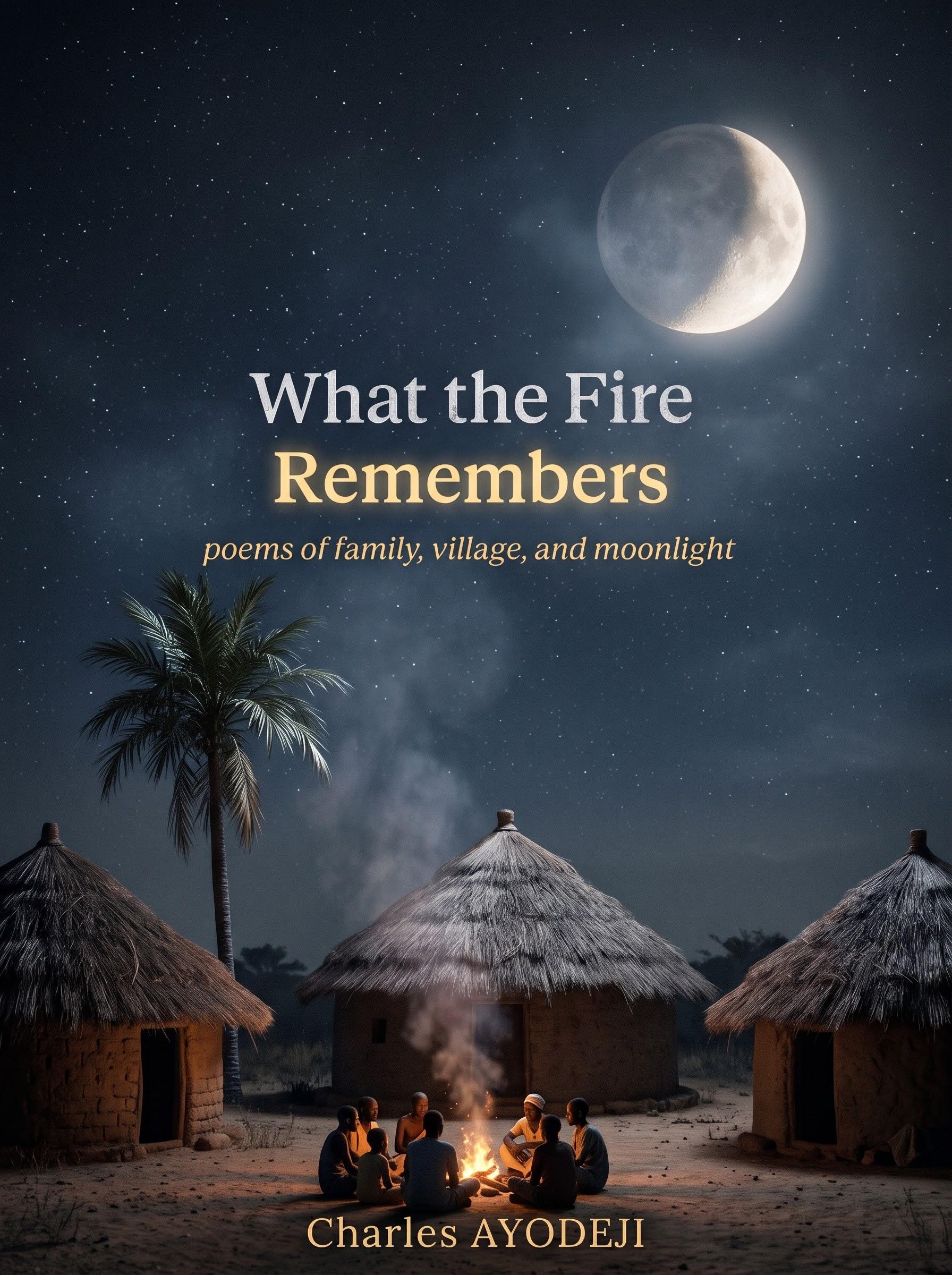
In reading What the Fire Remembers, what comes to my mind is not even whether we have to remember, but the scope of personal and collective memories. The agency of who remembers what, and the centrality of individual remembering to the collective scope of African collective resonance, is the central concerns of the collection. This issue is at the heart of what is important to the individual in the age of gross individualism and fragmentation. But centring the individual within their own contemporaneity—the individualism and fragmentation of today’s world—is not a simple one-way trajectory that we position in contrast with the traditional and collective perception of the poet. I believe it is T. S. Eliot who best asserts the nexus between this ontogeny of the poet, namely that the “historical sense, which is a sense of the timeless as well as of the temporal and of the timeless and of the temporal together, is what makes a writer traditional. And it is at the same time what makes a writer more acutely conscious of his place in time, of his own contemporaneity” (37). Placing remembering and memories within the fusion of what Charles Ayodeji tries to achieve in his collection is central to the trope of the kind of poetry that speaks to the African condition in a way that it stands at the border of the bondsmen of amnesia and the agents of memory.
Ayodeji centres memories and recollection at the heart of his book. He starts with “The Chair My Grandfather Left Behind” and takes readers through what we hold from the remnants of what the older generations left for us. For the poet, it is no longer that we wear the shoes of those before us, but he suggests that we sit in their chair and bear the weight of what they saw. He states that:
I have sat there sometimes to borrow his view,
To see what he saw when the whole world was new,
The mango tree leaning into the yard,
Children chasing shadows across the hard ground,
The same sky above me, the same sky above you, (8)
And in this tradition of trying to view things from their perspective, we are reminded that “Yet somehow the years have shifted what it means to look through” (8). This is a subtle but strong way of reminding us that the years are not static, and the experience of the grandfather who lived the African experience cannot be fully measured by the grandchild who tries to look through his lens.
The subject, however, is not whose view or perspective is better, but the poet is reminding us that times change with every generation, and hence their perspectives and visions define their sense of values. But again, this logic leaves us with more questions: what do the changing views of the different generations pose in relation to the past and the future? Because, after trying and no longer seeing the world of the grandfather, the poet leaves the chair “where it has always been,” to “Let dust gather gently like old kin,/ For some inheritances should not be moved./ They are meant to remain where they were loved” (8–9). And this is where the view of the poet becomes central, because in the last two lines, he answers the question that would bother you from the journey so far. He tells you that some inheritances mainly serve as reminders of what once was and hence leave you hanging in the empty space that shows what you were in the past.
What makes this engagement interesting to me is the Fanonian answer to the disconnection that shattered the world of the grandfather (pre-colonial ancestral knowledge) and brought the persona in the work into the space of colonial modernity: the continuous search for self. Fanon tells us that the African subject is shaped by the colonial encounter to remain in a perpetual state of asking the question, “Who am I?”
In the second poem, “The Radio,” the poet still follows the world of the grandfather and an object associated with him. The metaphor of inanimate objects as a vehicle of the poet’s recollection—as a dominant motif, which I will return to later—is central to the entire collection of poems. In this poem, the convergence of two worlds reflects how the old is in constant conversation with the present. This view held by T. S. Eliot, although in the aesthetic sense, is true to Ayodeji’s position. Eliot notes that “the historical sense involves a perception, not only of the pastness of the past, but of its presence” (37). In the poem, the poet walks through a recollection of how it seems like “the whole world had somehow entered our home” (10) whenever the grandfather turns on the radio. Even when the signal turns bad, as it usually happened with the radios we grew up seeing our grandfathers use, “he never complained; he just adjusted the dial/ And waited for the world to become clear again” (10).
The event recollected becomes more than just a grandfather listening to the news on the radio. What seems like an ordinary action becomes a philosophical pose—the grandfather’s action becomes a measure of the mental search to which the poet is committed.
I think of that now when my life gets loud,
When too many voices form a crowd,
When everyone speaks but nobody hears,
When silence feels heavier than all my fears.
I remember his fingers turning the knob,
Searching patiently for something worth hearing.
Maybe wisdom was never a speech.
Maybe it was the hand that kept searching
The wisdom and lesson for our poet are not just folk wisdom—it contrasts the simple pattern of mental strength in the world before with the powerlessness of our minds today. The poem also hints at the chaos of today’s existence, which would not have been too much of a problem for our ancestors. Hence, the modern world and its burden can only be addressed through the resilience and strength of our ancestors. This, again, for me, is deeper than it appears on the surface. Because, in a world where we are caught in constant chaos, we need to understand how our own systems work. This is why I feel that the constant claims of modernist liberals and orthodox Marxists that decoloniality is a repetition of the cries of the 60s, and that we are looking back too much, seem to reflect a grave misunderstanding of how remembering can be a way forward for the African future.
Also, in “The Red Dust of Home” and “What My Grandmother Called Rain,” the poet still takes us back to the spiritual base of the African world. He notes how connected people are to the earth and rain, even in the modern world. In the former, he notes that while we once complained about the dust, stones, roads, mosquitoes, and everything else associated with village life, “We never knew that one day/ We would miss the things we complained about most” (12). Everything the village represents stands in contrast with the city and its concrete structures, cold corridors, and pollution. Importantly, what concerns him the most is the absence of any spiritually soul-touching state in the city: “I walk on pavements that never remember my feet/ never keeping the shape of where I have been” (12). Furthermore, in the latter poem, rain is the subject of a connection with the soul of spaces. The poet makes us understand that the experience of rain in one’s ancestral home is different from how it is in the city.
Now when rain falls in the city,
Nobody calls it a visitor.
We call it traffic.
We call it delay.
We call it inconvenience.
We call everything beautiful by the wrong name. (14)
This states our understanding of nature. Again, I believe this conversation can be extended, and for me, it shows how we think in a capitalist world. For those in communion with nature, their understanding of rain is different from that of someone who has to go to work despite the weather because the capitalist boss would not give them a day off; profit must be made.
The collection employs inanimate objects as the central metaphors of recollection. From the first poem through to this one on rain, we see how the poet uses the chair, radio, earth, bucket, suitcase, and rain as tropes of remembering. What the Fire Remembers is a book of warmth—our collective remembering and the connection it brings between the past and the present. This conversation is germane in this phase of the African struggle for the retrieval of memories. In fact, studies are being conducted around the world on the need to remember so that amnesia does not seize the past in a world that is moving too fast. This is what makes Ayodeji’s collection interesting.
About the reviewer: Owoicho Oko is a critic, researcher, and poet. He is the author of We Will Sing Water and Now I Sing God into Stones. He writes from Benue and Abuja.


