Contemporary Nigerian poetry follows the path of asking questions of identity. But, for this age, identity does not solely follow the path of cultural conflicts—but also the conflict of an individual with his society and growing up. The poets, caught in the befuddling ideals of what it means to be an African in the postmodern age, continue to define their identity. They bring in actions and events from the everyday lives of people, and see where theirs fit. It is this ideal of belonging and individual agency that permeates Nasirudeen Muritala’s Zero Is Still a Beginning. The collection, made up of twenty-two poems, follows the subject of becoming and identity as its grand thematic priority amidst other issues which are affiliated with this grand subject. The poems follow the turmoil of psychological violence and how it creates a ruin in the universe of childhood.
From the first poem, “The House I Wasn’t Raised In,” Muritala raises issues concerning the way childhood often comes back to demand answers to certain unanswered questions, how we keep waiting for a resolution to certain absences that childhood cloaks us in, but are sure to never find answers. In the case of the persona, it is often questions of how different families are built on love in their everyday existence; however, he only learns of love and belonging during Eid. He notes that “I know my parents by blood/but blood never taught me how a father enters a room,/how a mother calls your name from the kitchen…” (8), and some of the little familial ties that bind other families. Hence, he grew up learning from the opening of other families’ progress:
I grew up learning family
from the outside of other people’s windows,
watching fathers carry sleeping children from cars
while mothers fixed their collars at the gate,
wondering what kind of warmth requires no invitation. (8)
The metaphor of viewing happy families through the window is where the poet throws the punch. It means he is an audience to the show of love, but he can only be a part of the spectacles rather than sharing in it. For the family that he watches from the window, there is no performativity in family relations; hence, theirs is not a life of “choreography of belonging” but a space built with love which does not require invitation. As an adult, the persona may not ponder what differentiates his family from the one he saw growing up, but “sometimes adulthood opens the same old door,” and he is visited by old questions where he stands “still waiting for a childhood / that never learned my address” (8).
The tempo of recollection and how childhood shapes our growth and journey resonate in the second poem, “Borrowed Fathers.” In this piece, the persona still speaks of what it truly means to have agency as a child. It is important here to note that the life of many children in Nigeria is marred by violence—most times, this violence is so subtle it looks like lots of things: discipline, love, and order. But more often than not, it is a reflection of the constituted violence which began with colonialism, military dictatorship, and then sits at the dining table in family houses, where it wears the toga of tradition. According to E. E. Sule, constituted violence “… attempts, overtly and covertly, to erase identity and subjectivity, to systematically deny the humanity of its victims.” And it takes a delicate and honest thrust to see how our collective memory of roughened love affects children.
The persona notes that “There were men who corrected me/ before they ever asked what had made me that way,/ their voices becoming walls in rooms/ where I was only trying to understand/ what it meant to belong somewhere” (9). In this kind of space where the poet learns “to read footsteps before faces,” fear rather than love rents the space, and ultimately, questions are swallowed “because some houses teach children/ that silence is another form of good behavior” (9). The burden of the persona is not only built on the intimidation and subtle violence which children encounter here; it is also the economic hardship that people have to bear. Often, young boys grow up too early, and they become “the shoulder, the answer, the warning,/ the one who had to sound certain/ even when fear was chewing through my voice” (11).
Here, childhood is swallowed:
I learned responsibility like a second language,
awkward at first,
then fluent from necessity,
while childhood stood outside the window
with its hands pressed against the glass,
waiting for me to come back and play (11) (Emphasis mine).
The first batch of poems is all built around the confessional streaks of the poet’s childhood. The theme is familiar to many boys who grew up in the early 2000s and are currently trying to match their journey with everything they have been through. But why is it important to look back—to take the vision back to where the rain began to beat us, not from a collective grand historical level, as Achebe puts it in Hopes and Impediments, but from the history of our upbringing as millennial who were victims of a society that was not even convinced of its own errors and the way its children were treated? Inherited grief does not leave; it lies somewhere in the subconscious and raises its head with many questions, and this is precisely what makes Muritala’s poems relatable to an entire generation.
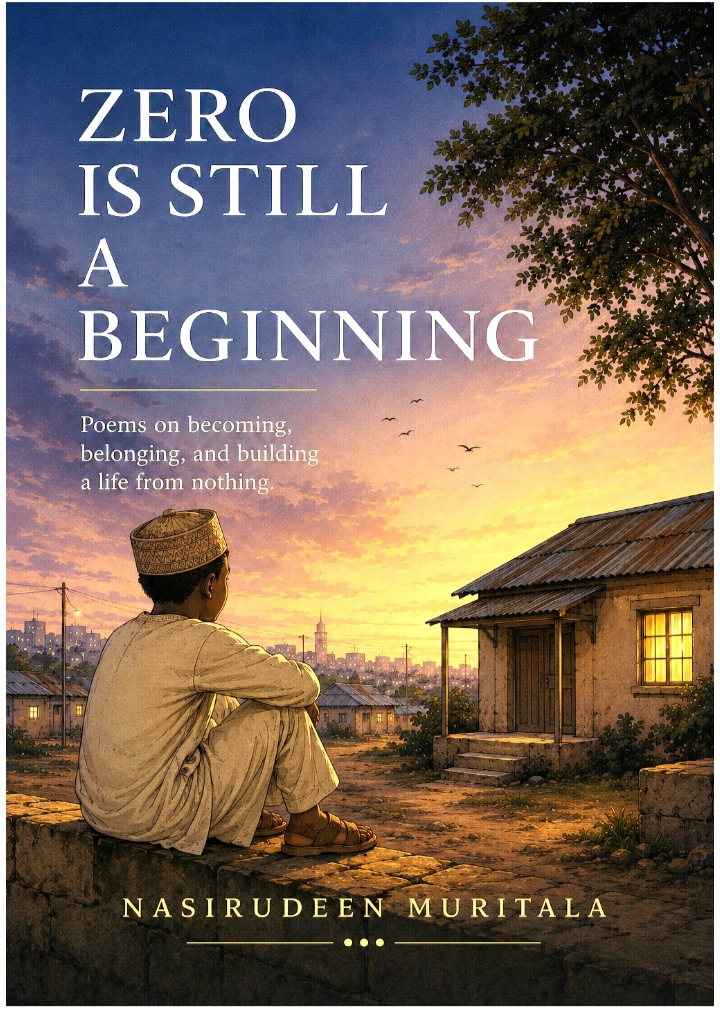
Also, one of the poems in this first section that is worth speaking of is the titled poem, “Zero Is Still a Beginning.” It is a poem of hope—a collective hope—that speaks to the collective belonging of an entire generation. The poem offers calm to young people who became older before their “birthday allowed it/ learned the mathematics of empty pockets,/ how to divide one meal between two people” (10). The poet reels out the responsibilities that come with having to bear burdens beyond one’s age, but:
…zero frightened me less with time.
I discovered that nothing is not the same as nowhere,
that a bare road is still a road,
and a boy with empty hands
can still build a life with them (10).
At this point, the persona understands that “from beginnings that looked like endings” does not mean a permanent stasis. And one must continue to build dreams and aspire for more.
What one finds fascinating about Zero Is Still a Beginning is the unconscious arrangement of the poems. As if in response to the mind of the poet and people with rough childhoods, even after offering hope in the titled poem, the later poems still reflect the terrible state of becoming which is often sown from childhood. “A House Without ‘I’m Proud of You’” and “Correction” reflect this reality. The two poems show how impostor syndrome is cultivated, and “because sometimes achievement is a lonely room/ when nobody knows how hard you fought to enter it” (14). In this space, every achievement comes with a burden, the burden of how the world sees you—how you begin to think that you are a fraud, and one day the world might just find out that everything you have attained is pure luck and might discover your lack of talent. This kind of feeling becomes a reason for a life built on external validation rather than a sense of self and defined beingness. And the persona puts it well when he notes that:
Perhaps that is why praise still feels strange,
why “I’m proud of you” can undo me faster than criticism,
why one simple sentence can reach
the little boy beneath the grown man
and finally give him somewhere to rest.
Within the tough terrain that the poet projects, there is always room for hope. And that is why, after all the going back and looking inward to the wound of psychological violence, the poet still reminds readers that a time might come when one wins. At that point, one wishes he could show his progress to the child he once was. It is upon this ground that the strong and resilient spirit of millennial in Nigeria is reflected. They are the generation that inherited the ache of their ancestors, but they are beginning to tell the stories of their belonging. This is why Muritala’s collection is instrumental. It does not only speak of the life of an individual; it speaks of the unspoken weight on the shoulders of a generation. The collection reflects on the anguish of an age, but also speaks of the ultimate victory that would come when the spirit refuses to break completely.
Owoicho Oko is a poet, performer, and researcher. He writes from Abuja and Benue State, Nigeria. He is the author of We Will Sing Water.

 SEVHAGE [MIDLAND] Reviews