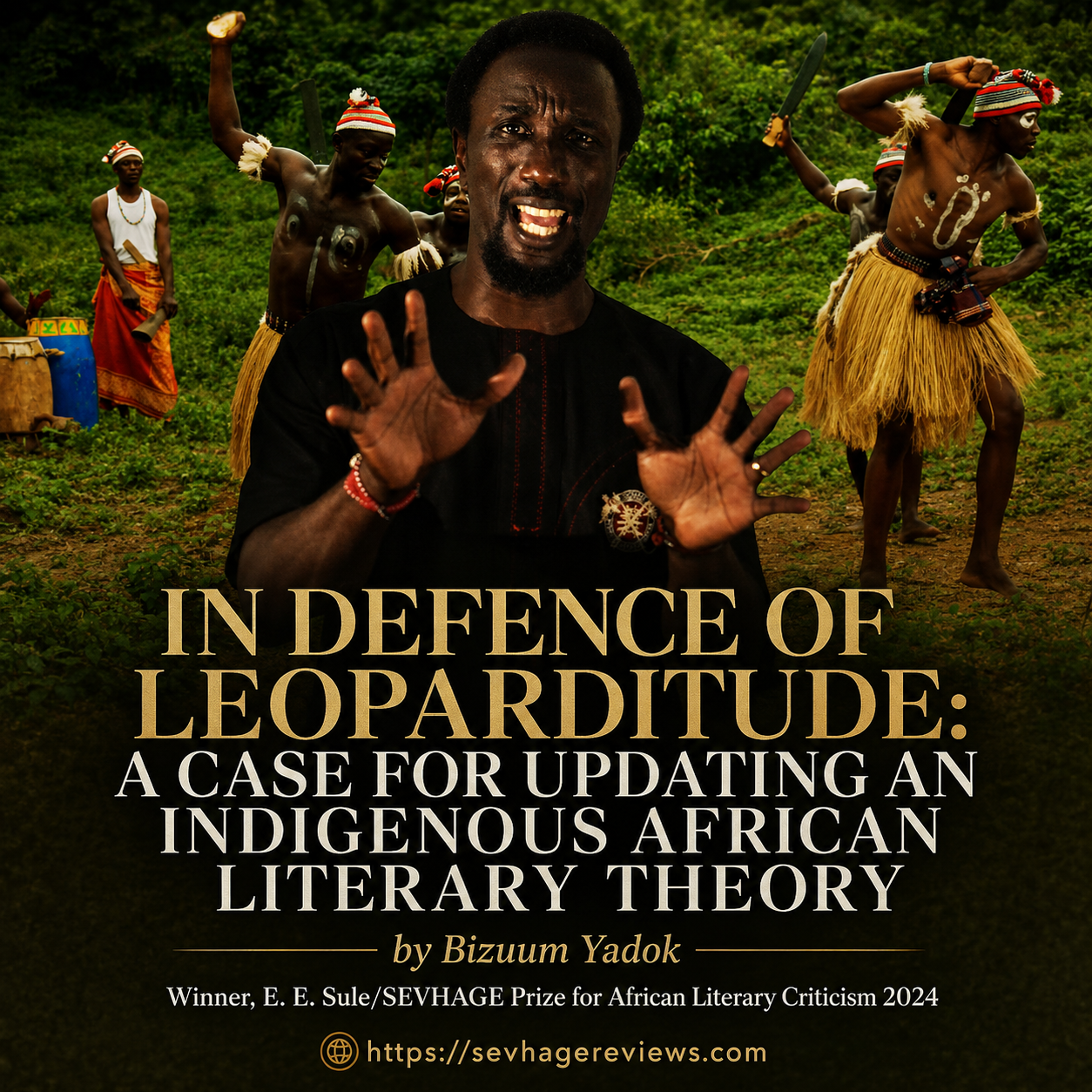
This essay won the E. E. Sule/SEVHAGE Prize for African Literary Criticism 2024
INTRODUCTION
Literary theory is the organised, systematic analysis and interpretation of literary texts. It involves the formulation of meaning from available evidence within the text (Bressler 7; Nayar iii). Literary theory comprises several interconnected strands, also referred to as literary theories, which are like coloured lights that enable consumers of art to comprehend, analyse, interpret, and appreciate literary works, whether in written or oral forms.
It is commonly held, although erroneously, that Africa lacked literacy, let alone literariness, until its contact with Europeans who came as traders, missionaries, or colonisers (Poncian 72). Copious evidence to the contrary points to Africa as the cradle of ancient civilisation, part of which Greece drew from Africa, especially ancient Egypt, thereby laying the foundation for European civilisation (Okafor 252; Anakwe 168). However, the poor transmission of writing systems and written literature across sub-Saharan Africa has contributed to the belief that Africans lacked any form of literariness, let alone empirical means of analysing it. Before the development of modern literary theories such as Marxism, psychoanalysis, feminism, formalism, structuralism, postmodernism, postcolonialism, and ecocriticism, much literary discourse dating from the period of philosophers such as Plato and Aristotle centred on the utilitarian function of literature versus its aesthetic value. Subsequent developments in literary theory, whether in Longinus, Horace, Sidney, Arnold, or Wordsworth, did not go far beyond the Platonic or Aristotelian schools of thought. In fact, a number of literary scholars opine that all modern literary theories are varying shades of either the extrinsic or intrinsic school of literary criticism (Ibrahim et al. 133; Safi and Rahmatzai 2796).
African literature, as it existed in several societies at the time of contact with Europeans, was largely transmitted through the oral tradition. Part of it still is, and it took quite some time for Western literary scholars to admit African oral literature into the literary gamut, until the groundbreaking works of British anthropologist Ruth Finnegan, Oral Literature in Africa (1970) and Oral Poetry (1977), demonstrated that the genres of the oral tradition aptly correspond to established literary genres. However, Finnegan was of the conviction that oral material was only a placeholder for the more enduring written material (166). Ugandan scholar Pio Zirimu rejected the forceful bending of the oral tradition to fit into the Western construct of literature, which prioritises written material over oral forms, and instead proposed the term “orature” for literary works composed and transmitted orally (Doki 45).
Applying Western literary theories to the interpretation of African oral forms became problematic, although a sociological theory such as functionalism proved more helpful in engaging with materials of the oral tradition. In Nigeria, for example, when writers in English such as Wole Soyinka, Chinua Achebe, John Pepper Clark, and Chukwuemeka Ike came on board, it became apparent that the oral tradition had a significant influence on their writing (Irele 78). By that time, postcolonialism—which, in this researcher’s opinion, is the most resourceful literary theory for African texts—was finding its feet as a means of navigating literary works from the many colonised regions of the world, often referred to then as Third World literatures.
It is, perhaps, in consideration of the limitations of Western-oriented literary theories that Mohammed Al-Bishak propounded “leoparditude” as a literary theory in 2000. The theory was put to the test in a book titled Leoparditude and African Drama: Professor Iorwuese Hagher’s Plays Explained, authored by Mohammed Al-Bishak in the same year. Leoparditude essentially refers to the domestication of a foreign language in either oral or written expression. The theory presupposes the location of both the author and the audience within a similar cultural space, where folk aesthetics and worldviews are readily understood (Al-Bishak xi). Leoparditude is coined from the name of the leopard, a ferocious wild cat strongly associated with Africa and known for its agility and cunning. The coinage also recalls black consciousness formulations such as Négritude and Wole Soyinka’s famous “tigritude” rejoinder. Négritude is principally associated with Aimé Césaire, Léon-Gontran Damas, and Léopold Sédar Senghor, while “tigritude” is associated with Soyinka’s critique of the movement. Some literary critics view Négritude as a theory, but its potency hardly transcends Francophone Afro-Caribbean literature (Jack 57). At the time when the movement was popularised, Negro aesthetics was its most prominent feature, but, just as with Anglophone, Lusophone, and other African literatures composed in foreign languages, the question of authenticity finds its way into the discourse. Thus, for example, Adrian Roscoe says, “if an African writes in English, his work must be considered as belonging to English letters as a whole and can be scrutinized accordingly” (x). By implication, any work written in English must be subjected to the theories of English literature, but that would yield only limited insight into African literature written in English. It is little wonder, then, that major works of African literature in English, such as Chinua Achebe’s Things Fall Apart (1958) and Ngũgĩ wa Thiong’o’s Weep Not, Child (1964), were initially dismissed as “anthropological” or “biographical texts” (Chinweizu et al. 7).
It is apparent that Western literary theories do not adequately explicate or interpret literary works emanating from Africa. However, postcolonialism, though not essentially a Western literary theory, was nonetheless midwifed in the West. It offers useful insights into the engagement of African literary production, but it is often generalised in its application to texts from formerly colonised countries and is not specific to African texts. Additionally, postcolonialism appears to be a theory in crisis. For instance, Anne McClintock’s famous article “The Angel of Progress: Pitfalls of the Term ‘Post-Colonialism’”, Kwame Anthony Appiah’s “Is the Post- in Postmodernism the Post- in Postcolonial?”, and similar articles by Tejumola Olaniyan examine the incoherence in the nomenclature and application of postcolonialism to African literature.
These considerations point to the imperative for indigenous African literary theories to optimally interpret African epistemologies, cultural nuances, and worldviews contained in African literatures, especially those written or orally composed in foreign languages. It is on this note that the author of this paper proposes leoparditude as a more beneficial theory for the interpretation of meaning in African literature. Although it was initially meant to explicate African drama, this article also seeks to refine and update leoparditude to accommodate all genres of literature, including performance poetry, which is the main thrust of the discourse. In particular, leoparditude will be employed to analyse Dike Chukwumerije’s tribute to Chinua Achebe, titled “Nna Anyi, Is It True?”, with the hope that it will yield a clearer understanding of the audio-visual text.
A CASE FOR LEOPARDITUDE
Just as the leopard has marked its presence throughout Africa, regardless of climate or vegetation, certain rhetorical forms and values are known to permeate various cultures across the continent, not to mention the continent’s shared colonial history, with very few exceptions, of course. Leoparditude was conceived to cater for the hybridity of the modern African in literary production. Accordingly, it lays emphasis on the domestication of a foreign language to reflect the peculiarities of folk aesthetics, tradition, and aspirations, thereby providing a basis for a shared tempo-cultural space between a writer and his audience and, by extension, between a performer and his audience, whether physically or virtually. When Al-Bishak first applied the theory to Hagher’s plays, he was able to unearth layers of meaning that contributed to the overall appreciation of the texts. The proponent of leoparditude was even more radical in his articulation of the theory, introducing terms such as playwatchers (audience), playteam (cast), players (actors), playeress (actress), and playique (critique of drama), among others. In analysing a play, Al-Bishak advanced twelve basic tenets of leoparditude, captured in his seminal book as follows:
- The Artist is an African or African in Diaspora.
- The artist writes for the Africans or Africans in Diaspora in the sense that he represents their collective hopes and aspirations.
- The artist opposes slavery, colonialism, and imperialism in Africa and in any form.
- The writer produces a simple art that is graceful and meaningful, yet unencumbered by complex personal imagery or effete mythologies. To wit, it explores the rich aesthetic forms of the African folktale but with revolutionary contents.
- Domesticates any foreign language in an effective way to communicate with the people.
- It identifies with the oppressed in mind, soul, and spirit.
- It imbues the Africans and the oppressed people with hope, courage and vision through pungency in its attack and clarity in its message.
- It promotes Africa and the Africans in global affairs so as to occupy progressive leadership positions. It also exposes African renegades who become puppet leaders of imperial masters.
- It uses multi-ethnic/racial characters and multi-ethnic/racial settings in art to achieve universal fraternity and harmony. And despises gender discrimination.
- Teaches liberation of the people in a scientific manner.
- Does not indulge in self-overglorification of Africa and the Africans or wallow in self-pity.
- Does not produce art based on the “intellectual terms” of non-Africans.
Considering the density of the principles of leoparditude and some of its Marxist inclinations, the author of this article has taken the liberty of reviewing Al-Bishak’s postulation in view of the increasing diversity of African literature, the evolution of digital media, globalisation, and emerging literary subgenres. This is necessary because any theory limited to a temporal or spatial frame risks underachieving its purpose. Thus, in light of the foregoing, Al-Bishak’s tenets are revised and condensed into five major tenets, as follows:
- It domesticates any foreign language in an effective way to communicate essentially with Africans.
- It explores the rich aesthetic forms of African folklore or worldviews.
- It locates both the artist and his primary audience within the same tempo-cultural community, whether in Africa, in the diaspora, or in virtual space.
- Artistic production is based mainly on African epistemology rather than on the “intellectual terms” of non-Africans.
- It detects and exposes instances of colonialism, neo-colonialism, or imperialism in African or African diasporic literature.
ENGAGING LEOPARDITUDE IN DIKE CHUKWUMERIJE’S “NNA ANYI, IS IT TRUE?”
Dike Chukwumerije’s “Nna Anyi, Is It True?” (a tribute to Chinua Achebe) is a fine example of performance poetry, sometimes referred to as “spoken word”, “live poetry”, or “contemporary oral poetry”, in the new media (Yadok and Jeremiah 52). Performance poetry is a burgeoning offshoot of modern African poetry that draws generously from the oral tradition and popular culture. Chukwumerije himself is, by various assessments, one of the most respected and prolific performance poets in Nigeria (Okoye and Ugwu 7; Omajuwa and Onovwiona 33). He is also a lawyer by profession and a multiple award-winning writer across various genres of literature. “Nna Anyi, Is It True?” is one of Chukwumerije’s most performative poems, in which words, voice, cadence, dance, gestures, lighting, and background sounds blend to produce an exhilarating sensuous aesthetic experience. The poem was composed shortly after Chinua Achebe’s death in 2013, but the performance was recorded in 2014. It is a modern dirge that begins with a shocking lament before developing into a eulogy for its subject, Chinua Achebe.
The domestication of English as a foreign language essentially refers to its appropriation and abrogation in African usage through such strategies as selective lexical fidelity, interlanguage, semantic idiosyncrasies, and phonological conformity. The poem contains a considerable mixture of Igbo and English vocabulary and expressions. As such, the indigenous African language stands on a par with English, without yielding to the convention of italicising non-English words. This is evident from the title of the poem itself, where we find a clear case of selective lexical fidelity in the expression “Nna Anyi, Is It True?” The phrase “Nna Anyi” loosely translates as “our father”, but the English translation falls short of its fuller meaning in Igbo—which is something closer to “our revered father”—and this may have informed the poet’s decision not only to retain the phrase in Igbo but also to repeat it at various intervals throughout the poem. The phrase “Nna Anyi” is attributed to the subject in an ambiguous sense because he is a biological father as well as a father figure to many. More importantly, he is widely considered a paternal figure in modern African literature because his magnum opus, Things Fall Apart, although not the first African novel to be published in English, challenged Western stereotypes of Africa while advocating the dignity of African tradition, with Igbo tradition as a central example. The poem also contains extended expressions in Igbo, as seen in its opening lines:
Asi m ka m bia malu
I came to find out
Na ife I kara bu eziokwu
If what they said is true
Asi na ugo naabuo
That the eagle is gone
Nna anyi, eww u! eww u!
Our father, oh! Oh!
Onwu adighi atu egwu
Death has no respect
Irigrigi, igirigi adaa
The dew, the dew has fallen
Eww u, eww u, eww u!
Oh! Ah!
Nna Anyi Ukwu
Our great father
Nna ayi, Is it true? (0:22–1:00)
It is important to state that, besides transcribing the poem, the author relied on the competence of an Igbo speaker for the translation of the verbal text. The video was sourced from YouTube, but none of the verbal text appeared on screen or was translated, as is often the case when a language other than English is used. In addition, the author has taken the liberty of using time stamps to locate sections of the poem for reference purposes.
English in this poem is also employed as a foreign body bearing an African spirit. As such, interlanguage assumes a crucial role in the delivery of the poem, although its manifestations are not always immediately apparent:
It is true that your name was called in the night?
A si na afutu gi n’ofe ndi
(They said they saw you across)
Somebody said they saw you across the river, on the river
And they called to you but did not answer . . . (1:25–1:43)
Again, there is an instance of selective lexical fidelity in the excerpt above, as the poem moves seamlessly between Igbo and English. The alternation between the two languages creates a bilingual texture that reinforces the shared linguistic and cultural space between the performer and his primary audience.
Another example occurs in the following lines:
It was he who took our stories
And wrote them in the underbelly of the heavens
That the farthest ends of the earth may know the name— (2:50–3:00)
The opening construction, “It was he who took our stories”, places particular emphasis on Achebe as the agent responsible for carrying African stories beyond their immediate cultural environment. The construction also enhances the declamatory quality of the performance, allowing the performer to foreground the subject before developing the image of writing African stories “in the underbelly of the heavens”.
The appropriation of a foreign language, especially in performance poetry, may also be expressed through phonological and prosodic features, particularly where the performer’s accent and speech rhythms shape the delivery of English words. In some instances, this can be heard in patterns of stress and intonation, as in the following:
Is it true that the calabash broke and I will no longer drink from it?
That the sound of the drums will no longer move (1:02–1:09)
In the excerpt above, the performer places marked vocal emphasis on “no longer” in both lines. This repeated prosodic pattern contributes to the African inflection of the performance and complements the indigenous images of the calabash and drums.
In all these instances, meaning is not lost on the poet’s audience because performer and audience operate within a shared cultural space, albeit a virtual one in this case. For the poem’s primary African audience, therefore, meaning is largely accessible without extensive recourse to external social, historical, linguistic, or anthropological materials, since performer and audience occupy a broadly shared cultural space.
AURAL AND VISUAL AESTHETICS
Dike Chukwumerije is always fully conscious of his visual and aural aesthetics, whether in live performances or studio recordings. Usually, he takes into consideration the stage backdrop, facial expressions, body movements, including dance, background sounds or music, lighting, colours, voice modulation, and other features that contribute to the overall audio-visual appeal. In the poem “Nna Anyi, Is It True?”, sourced from YouTube, the visual and aural aesthetics are integrated with his crafted words, producing a scintillating performance that keeps his virtual audience engaged with the screens of their devices. Catherine Dawson opines that visual rhetoric also considers “other forms of human communication through video such as colours, form, medium, scale, location, context, and purpose”, with each part of the video contributing significantly to the message being communicated (369). This article may not deal exhaustively with both the aural and visual semiotics, but it will highlight the audio-visual aesthetics of the poem.
The visual and aural texture of the poem offers rich non-linguistic material that has a direct bearing on its discourse. There is generally more darkness than brightness in the video until the final quarter of the poem, but the brightness diminishes to a halo towards the end, corresponding with the diminishing sounds and voice of the poet. Here, Dike Chukwumerije wears his signature performance attire—a black T-shirt with “Simply Poetry” inscribed on it. The performer is also seen in other outfits, such as a shirt and traditional Nigerian attire resembling a kaftan. In another instance, he is shown bare-chested, with a piece of cloth tied around his waist, as are his accompanying dancers, lending weight to Olanike Olaleru’s submission that “the African performance poetic experience essentially involves enactment through spoken words, bodily gestures, and other non-verbal expressive modes” (203). In the poem, both the videotext and audiotext, described by Nikita Adjirakor as non-linguistic images or sounds embedded in a performance (155), communicate almost as powerfully as the verbal text of the poem. The drums and the oja flute, for example, both indigenous musical instruments associated with Igbo culture, are featured prominently in the audio and visual background of the poem. There are also distinct sounds that enrich its musical background. Additionally, certain portions of the poem are echoed, while vocal tones are manipulated in accordance with the pragmatic intentions of the poet. Asked about the role of tone, voice modulation, cadence, and sound patterns in his poetry, Dike Chukwumerije replies:
I think those things are critical, modulation, tone of your voice, the texture of your voice, the sound patterns. I think they are critical to giving your performance character, making it enjoyable and making it interesting. You know, so it is a big part of performance even if you don’t do anything else. You have to do something with your voice and the way you speak. It’s your primary tool for performance. (Chukwumerije)
From his voice, we encounter a lamenting persona from the beginning of the poem until a little past its midpoint, but the voice assumes a celebratory texture in the final quarter. The voice alone registers the performer’s transformation from a broken persona to a brave one, all within the experience of grief.
Images of the subject’s literary output are displayed at intervals as the poem is performed, including Things Fall Apart (1958), Arrow of God (1964), No Longer at Ease (1960), and Anthills of the Savannah (1987). Interestingly, the poet makes no direct mention of Achebe by name throughout the poem and does not show his face until the poem draws to a close. However, Achebe’s name is clearly visible on the book covers displayed during the performance. Images of the lion, elephant, and iroko tree are also displayed in quick flashes, symbolising Achebe’s strength and stature in the literary world. Aspects of Igbo flora and fauna are also featured in the poem. Although the poem is substantially rendered in English, much of its visual, aural, and cultural texture evokes Igbo culture. Even the English delivery is inflected by the performer’s Igbo-accented speech and by the rhythms and tonal qualities associated with lamentation, giving the performance some of the qualities of an Igbo dirge.
CONCLUSION
Literary theories enable critics to better appreciate literary works. However, many of them may prove inadequate for the effective interpretation of African texts in oral or written forms. Performance poetry in English, as an emerging poetic subgenre that has found increasing expression in new media, has attracted relatively little attention from literary scholars, partly because of the dearth of indigenous African literary theories suited to its analysis. As such, leoparditude provides a potentially useful hermeneutical tool for literary discourse. As a test case, Dike Chukwumerije’s “Nna Anyi, Is It True?”, a performance poem in celebration of Chinua Achebe, is analysed using leoparditude. Through the prism of leoparditude, one can discern how a foreign language may be adapted to accommodate the creative devices and verbal expressive modes of African literature, enabling a writer or performer to communicate effectively with an African audience. Furthermore, folk rhetoric and African worldviews can be suitably adapted within the same medium, thereby enabling African literary production to operate on terms grounded in African epistemologies.
[This essay won the E. E. Sule/SEVHAGE Prize for African Literary Criticism 2024 and appears in this journal as edited by Profs Hyginus Ekwuazi and Maria Ajima, and Su’ur Su’eddie Vershima Agema]
Works Cited
Achebe, Chinua. Morning Yet on Creation Day: Essays. Anchor Press, 1976.
Adjirakor, Nikitta Dede Abena. “I Go for the Vibe”: Hip-Hop and Spoken Word as Aesthetic Practices in Dar es Salaam. 2021. University of Bayreuth, PhD dissertation.
Al-Bishak, Mohammed. Leoparditude and African Drama: Professor Iyorwuese Hagher’s Plays Explained. Supreme Black Communications, 2000.
Anakwue, Nicholas Chukwudike. “The African Origins of Greek Philosophy: Ancient Egypt in Retrospect.” Phronimon, vol. 18, 2017, pp. 167–80. https://doi.org/10.17159/2413-3086/2361.
Appiah, Kwame Anthony. “Is the Post- in Postmodernism the Post- in Postcolonial?” African Literature: An Anthology of Criticism and Theory, edited by Tejumola Olaniyan and Ato Quayson, Blackwell Publishing, 2007, pp. 654–64.
Bressler, Charles E. Literary Criticism: An Introduction to Theory and Practice. 3rd ed., Prentice Hall, 2002.
Chukwumerije, Dike. “Nna Anyi, Is It True?” YouTube, 2013, https://www.youtube.com/watch?v=GsDJ5CUCafI. Accessed 26 Jan. 2023.
Chukwumerije, Dike. Personal interview. Conducted by Bizuum Yadok, 27 Nov. 2023.
Dawson, Catherine. A-Z of Digital Research Methods. Routledge, 2020.
Doki, Jeff Godwin. Poetry and Global Peace. Jos University Press, 2023.
Egya, Sule E. Nation, Power and Dissidence in Third Generation Nigerian Poetry in English. Unisa Press, 2014.
Finnegan, Ruth. “The How of Literature.” Oral Tradition, vol. 20, no. 2, 2005, pp. 164–87.
Ibrahim, Abdullah Mahmod, et al. “Literary Theory and Its Role in Modern and Contemporary Criticism: A Critical Approach.” Research Journal in Advanced Humanities, vol. 5, no. 1, 2024, pp. 131–44. https://doi.org/10.58256/zebr1z41.
Irele, Abiola. “Orality, Literacy, and African Literature.” African Literature: An Anthology of Criticism and Theory, edited by Tejumola Olaniyan and Ato Quayson, Blackwell Publishing, 2007, pp. 74–82.
Jack, Belinda Elizabeth. Negritude and Literary Criticism: The History and Theory of “Negro-African” Literature in French. Greenwood Press, 1996.
McClintock, Anne. “The Angel of Progress: Pitfalls of the Term ‘Post-Colonialism.’” African Literature: An Anthology of Criticism and Theory, edited by Tejumola Olaniyan and Ato Quayson, Blackwell Publishing, 2007, pp. 628–36.
Nayar, Pramod K. Contemporary Literary and Cultural Theory: From Structuralism to Ecocriticism. Pearson, 2010.
Okafor, Victor Oguejiofor. “Diop and the African Origin of Civilization: An Afrocentric Analysis.” Journal of Black Studies, vol. 22, no. 2, 1991, pp. 252–68. https://doi.org/10.1177/002193479102200207.
Okoye, Chike, and Stella Okoye-Ugwu. “From Minstrelsy to the Spoken Word Poet: Oral Tradition and Postcolonial Nigeria.” Cogent Arts & Humanities, vol. 8, no. 1, 2021, pp. 1–15. https://doi.org/10.1080/23311983.2021.1933306.
Olaleru, Olanike. “Oral Performance Strategies and Characteristics in the Poetry of Niyi Osundare and Akeem Lasisi.” Orality, Textuality, Society: New Perspectives on Nigerian Literature and Culture: Essays in Honour of Gboyega Kolawole, edited by Sule E. Egya, Peace Sorochi Longdet, and Adegboye Adeyanju, Sevhage, 2023, pp. 203–23.
Omajuwa, Ogugua, and Solomon Onovwiona. “Contemporary Realities in Nigerian Spoken Word Poetry.” International Journal of Arts, Languages, Linguistics and Literary Studies (JOLLS), vol. 11, no. 3, 2022, pp. 31–38.
Poncian, Japhace. “The Persistence of Western Negative Perceptions about Africa: Factoring the Role of Africans.” Journal of African Studies and Development, vol. 7, no. 3, 2015, pp. 72–80. https://doi.org/10.5897/JASD2014.0317.
Roscoe, Adrian. Mother Is Gold: A Study in West African Literature. Cambridge UP, 1977.
Safi, Saadatullah, and Saeedullah Rahmatzai. “Literary Criticism and Contemporary Critical Theories.” International Journal of Creative Research Thoughts (IJCRT), vol. 8, no. 6, 2020, pp. 2795–2801.
Stroebe, Margaret, et al. “Cautioning Health-Care Professionals: Bereaved Persons Are Misguided Through the Stages of Grief.” OMEGA—Journal of Death and Dying, vol. 74, no. 4, 2017, pp. 455–73. https://doi.org/10.1177/0030222817691870.
Yadok, Bizuum Godwill, and Venmire Peace Jeremiah. “The Imperative of Contemporary Oral Poetry in Curbing Insecurity in Nigeria.” Journal of Languages and Literature (JOLALI), vol. 6, no. 1, 2023, pp. 53–59.


