In this conversation with SEVHAGE Lead, S. Su’eddie Vershima Agema, Dr. Peace Longdet discusses her background, her poetry, language and art. Enjoy and please, share.
- First things first, for those of us who have a faint idea of who you are, who is this poet and what is her backstory?
I’m Peace Sorochi Longdet, a lecturer with the Department of English, Federal College of Education, Pankshin. Some will like to describe me as Jack of all trades and master of all, hahaha. This is because aside from being a lecturer, I am also a training consultant in areas such as financial literacy, business development, organisational development and online training. I have developed and reviewed training content for international organisations. Hence, the trade name ‘Jack of all trades.’ My academic life has not in any way been stagnant as I have participated in both national and international conferences, some with sponsorship from funding bodies, won through contest. My academic papers have also been published in journals within and outside Nigeria. I am a firm believer in the tripod precept of TRUTH, JUSTICE and PEACE. I have engaged in conversations around this in multifaceted spaces.
I would say that I started trying my pen on paper several years back in my teenage years first, out of curiosity and then hobby. I loved to read. I read all books, both simple and complex. That I think was what inspired by journey. As the years rolled by, I tried my hands on short stories and plays as school projects, although none was published. I see my writing as a conversational tool. I use it to engaged all that I perceived as wrong in governance and the society at large.
- You are a poet and folklorist with your debut poetry collection, Enablers due out in March 2022 from our SEVHAGE stables and your folktale collection, The Kob Antelope Woman and other Human-Animal Folktales from the Mwaghavul of Nigeria coming much later. Well done on this outpouring! What burns your creativity and is there any work that is hiding somewhere which you will soon share with the world?
Thank you. I’m influenced by the freedom to explore societal happenings and translate them to readable bits. I love to experiment with new ideas and the knowledge that I have an audience who will read my creative pieces. These are elements that give my imagination a boost. For now, I would love to work on turning all the manuscripts of folktales I collected during my PhD study into texts both for adults and children.
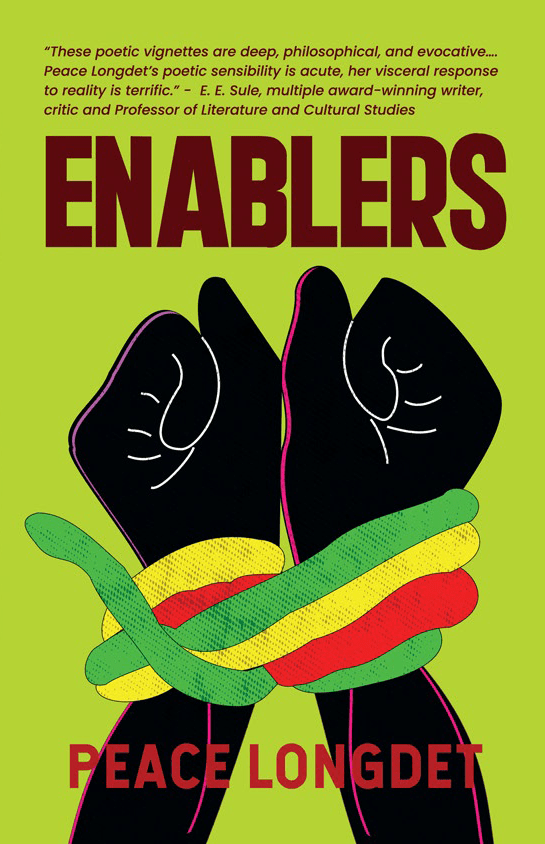
- Enablers is a collection of fifty-seven poems with several themes that mainly focus on contemporary happenings in society. What was the writing process like and what are the things you emphasized in the book which you think are worth mentioning?
The writing of the collection was not really a planned and organised process. The first couple of poems in the collection were written in 2016. And the entire process has been bits of events from 2016 to 2021. Some of the poems in this collection appear on my Facebook timeline. I would say that the feedback from that space gave me the nudge to put all the bits together into this publication. The collection is filled with diverse themes and each of these themes resonate with the occasion that inspired their crafting.
- What would you say was your most challenging experience in writing it, on the one hand, and on the other, you most rewarding experience?
As I said earlier, the processing began in 2016 until 2021, 5 years. I wouldn’t really say that there was any challenge putting this piece together because most of it was spontaneous. I get the inspiration and reach out to anything writing tool to put down my thoughts on paper. Maybe I would say the process of fine-tuning the thoughts, deciding whether to punctuate or not to punctuate and how simple the language should be, was challenging. The choice of stringing the words simply was a deliberate choice influenced by readers’ feedback on some of the poems on my Facebook space. Making this choice of simplicity was the most rewarding experience. Because I believed that my poems were direct messages. Hence, I should be able to communicate to a broader range of audiences.
- What is the craziest thing you have done with poetry, and what is the craziest thing poetry has done for you?
Hahaha, well, let’s say I have used poetry to heal from the loss of love. And poetry has turned me into a self-conscious activist.
- So, do you have any favourite poems or books or authors you want to share with us? Of course, we also need to know why too.
Maybe I will respond in a collective term; I love South African protest poems. These poems speak to the reality of their time. I also love reading Niyi Osundare; his poetic form and language are enchanting.
- Your work, Kob Antelope is a collection of native human-animal folktales written in English and another language, the language of the Mwaghavul. Can you tell us a bit more about this language, about its people and what inspired the project?
The Mwaghavul people are one of the prominent ethnic groups domiciled within the Central Zone of present Plateau State of Nigeria and they are considered one of the large ethnic groups in the state; other large language groups in Plateau State include Berom, Ngas and Gomei. Historically, the Mwaghavul people were said to be among the former inhabitants of the Lake Chad area before their migration towards the south along with their kin, the Ngas, Tal, Mupun, Goemai, among other Chadic language groups. I have taught oral literature for a couple years and discovered that most minority languages, especially in Plateau state do not have available text that could be used for this course. This is the general need that inspired the work. Also, the forces of globalization and consumerism are threatening our traditional culture and values sipped in these tales. Collating and documenting these tales, I believe would go a long way to preserve the rich oral folktales of the people as well as making them accessible to a wider reading audience.
- Let us in on the story of your collating, translating and putting together the stories for The Kob Antelope Woman. What was the most challenging part of that and what was the best part of that writing journey?
Hmm! This was a whole new game. The entire process was quite tedious but I think the most difficult part was the fieldwork especially being able to keep my recording equipment on. At some point, I had to go to the field with a generator. The best part of this journey was that I had an amazing team of research assistants who worked day tirelessly with me on this project.
- What’s your view on African culture and the assertion that our languages are quickly dying with little hope of retaining them? As a follow-up, what practical ways do you think we can use in capturing these, except your obvious style of writing and translation?
I agree with this view. During my fieldwork getting my respondents to remember these tales was not all that easy. There are many factors responsible for the gradual eroding of our languages and culture, urbanisation, preference for English Language as the language of the elite, intermarriages, among others. I have publications on how we can leverage on technology e.g. animation, digital archiving, print media among others as possible ways of preserving our culture,
- What will you say has been your most memorable moment as a writer thus far?
I get fulfilled when I receive feedback on any of my writing. It works on my emotion like an active volcano. Hahaha
- Any other thing you would like to say?
Although some people see creativity as an innate talent, I believe that it is learnable. It is like any other learnable skill, but one critical factor is that one must have the interest to be able to learn how to engagingly knit words together with the sole aim of passing a message across. I want to continually pass a message; one way is not to let the ink run dry.
Peace Longet’s collection of poems, Enablers, is out and available for purchase. Please, send a mail to sevhage@gmail.com. Happy World Poetry Day!!


 SEVHAGE [MIDLAND] Reviews
This is so heartwarming.
Thank you for blessing this generation with your creative writings.
Happy world poetry day.
Dr. Peace Longdet is a gifted orator and I simply admire her choice of simple language in literature. She has made me like reading her message through literature something I see as boring before and difficult to understand coming from a different field. All I would say is well done and keep the ink flowing ma
Sorochi peace Longdet is one genus gifted not only in Language and art but also a fighter for peace and justice and equity, a voice in defense of the oppressed and one who balanced her sense of judgement with the fear of her Creator
Always proud of you my teacher and model