Title: Scripture
Author: Jide Badmus
Genre: Poetry
Number of Pages: 73
Publishers: SEVHAGE Publishers
Year of Publication: 2018
Reviewer: Eugene Yakubu
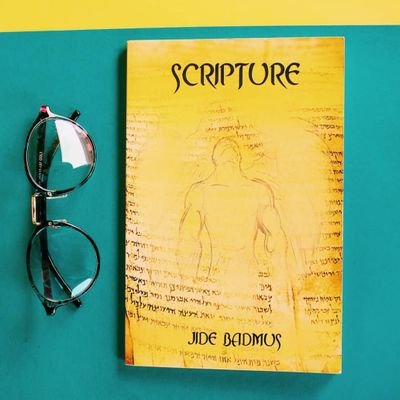
In approaching this collection of poetry Scripture, it is important to remember two important facts about the author. Since he published There is a Storm in my Head, he has set himself as a poet with mastery of words and also an acute imagination. The witty and rhythmical preface to the collection prepares the reader wholesomely into a roller-coaster ride with subtle creativity delivered in condensed language and carefully chosen words. The poet enthralls readers into his poetic state of mind with a creative allusion to the Holy Bible in the preface “From Genesis the word was god/ Like Moses’ rod”. This prepares the reader to expect more of the witty aphorisms and grammatical and literary acuity which Badmus, the “poetry’s mouthpiece” (xi) vehemently delivered on.
The reader needs to thread into the world of this sophisticated poet with caution to avoid misinterpretation of his tremendously nuanced figurations and themes. For instance, in the poem God, despite its graphic and obviously seeming title, the last line of the poem undermines the divinity of the theme and title. After all, the image in the mirror the poet would see will be strictly his; hence this is a reflexive musing crowning the poet the god of himself. This intentional ambiguity and elusiveness is applaudable for it offers the reader a chance to partake in the poetry itself and not just be a passive reader waiting to digest the poet’s creativity. Badmus’s poems awaken the reader and revive the smoldering embers of his imagination. It allows the reader to go beyond the words on the paper and read deeper meanings into the poet’s psyche and mental state while scribbling his imagination.
The preceding poem Deity, undergirds the earlier assertion, for the poet calls himself a “deity”, who “mould[s][…] dust of thoughts/ Into bodies of words” (4). He takes charge of himself as creator, but of words and emotions through poetry, and sits gracefully as king waiting to “consume incense of rhymes” and “drink from gourds/ Of expressions” while “word worship [him]”. The image the poet creates is that of a Christian God whose subjects adore and worship but nevertheless juxtaposed with that of himself as poet who gives life to words and sits from afar watching them take up meaning in the readers and stirring emotions. The poet knows too well the power of words and how far they can go to influence people, stir feelings and arouse emotions; this is evident in his carefully chosen diction. Worthy of mention is the fact that the poet consciously structured the poems in the collection to support his transfiguration from taking up form firstly as “god” in the first poem God to eventually possessing the power to command, mould, and directs words to conjuring emotions in readers in the preceding poem Deity.
Scripture is charged and adorned with sublime metaphors, lofty word play and striking creativity. The poet reconciles his unrestrained imagination with his mastery of words. Thus, he effortlessly drives his ideas home and chooses from his pool of words for fitting words that will suffice each mental picture to relate vividly to readers.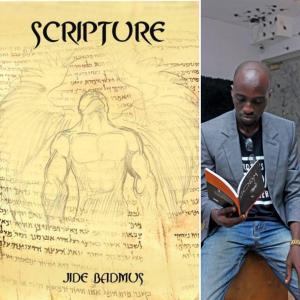
Badmus writes tremendously on even the most trivial of feelings, ideas or objects in amusing ways; using witty aphorisms and turgid vocabularies to communicate. His perceptions are as keen as his diction. His poems are philosophical, especially I Long for Deep Nothings, where the poet tries to reconcile the surreal confluence between darkness and light, “of sweet, sour and bitter” (7). The poet interrogates his soul and challenges fixed categories of nature, demanding answers for the most unheard of questions, engaging his existence while bidding to conquer his fears and master his success. Badmus has an eye for details. He captures every image precisely, every idea concisely, every word fittingly and every literary element working to support the other. He shows signs of sophisticated artistry and literariness. His metaphors are revealing, his similes relatable and his images striking. His poems speak articulately while eluding the full impact of clarity like a dream. We can read his poems without strenuous effort— the words, the images, the tone, the mood, the atmosphere and the structure— but we cannot strictly fathom the point they tender. Keeping us in this spectral point of half-knowing, of mystery-within-familiarity and surreality, had been the core technique of his style of poetry since his debut with There’s a Storm in my Head.
In this collection, formalist literary critics who study the intrinsic aesthetics in a work of art will have a masterpiece of refined artistry. The poet evokes freshness of sensation. He expresses fresh ways of experiencing the world using purely literary devices to produce the effect of freshness in the reader’s experience of a literary work. He deviates from ordinary language and estranges the reader from normal expression by violating the sound and syntax of language through rhyme schemes and rhythms, and also setting up special mode of language defined in terms of their opposition to everyday language. Hence, the poet’s assertion in his twitter handle thus: “My words are trained to talk in whispers and still be distinct in the noise.”
The poem Paper God is charged with images of the poet’s ability to take up different shapes as he does with words. He sees himself as a paper which prisons words “of mental spheres” and like “molten metal”, which is malleable according to his mental state, “like air” fluid and unrestrained, “like water” which freely “creep into cracks and crevices”; still yet he “fold[s] like a smile” and a “poem in a pen’s mouth”. Different shades of personality which could either be a “A lover, a friend, a gun,/ A god”, depending on the poet’s temperament and the different people he has to relate with. The poetic symbols signifies something else, a range of reference beyond its initial meaning which the reader has to uncover by carefully following every line and thought in the poem. What an interesting poet, tossing the reader’s mind up and about through the darkest caves and bright sky, the gloomy prison and open spaces but never for once boring him.
The second chapter in the collection Sunset in Paradise contains emotional and sensual poems that glorify love and romance. The poems read like a verse from a lyric adoring the beauty of the poet’s love and corporeal body. As one reads through the section, the poet arouses a certain tingly sensation rippling across the reader’s mind that reminds him of the beauty of love and even the sensory memory of the reader’s romance. In the poem Fountain, the poet compares his lover’s eyes to a “warm fountain” and her “gaze sails/ on glowing streams of dreamy pupils”. The poet captures the images wholly and makes sure to revive nostalgic feelings in any reader.
In the poem While I wait… the poet adores his lover’s body and worships her gracefulness for her beauty caught his attention like “a collar to a shirt/ Or lapels to a jacket”. He is calling on her to let go of her reasoning and caution and “just flow with the tide”. While I Wait is a metaphysical poem, which despite its sensual and amorous undertones still reminds the reader of the ethereality of life like Andrew Marvel’s epic poem To His Coy Mistress. The poet challenges his lover “when will you respond to my plea?/ When will you grant my request?”. Trying to remind her of the brevity of life for he will not live forever. Alas, he will wait and while he waits write her love poems, but she has to hurry up and beat the never-stopping time: “Please dear, decide, make haste…”
 The soul-lifting poem Fortress has the capacity to motivate and reenergize any reader. It is deeply humanistic and celebrates human dignity. The poet reminds the reader of how graceful and wonderfully made he or she is. He reminds the reader to take pride in his life and hold on to being him/herself.
The chapter When gods Make Love to Men and When Words become Moans are on the surface libidinal and erotic, but a deeper look will reveal the poet’s genuine creativity and beautiful imagery. The poet says less than he means, hence psychoanalytic critics will have a full time debating on the hidden meaning hanging carnally on the words in the pages. However, the poet, who is masterful at wordsmithing and crafting images, can be permitted to dally in his ambiguity for he has provided hints here and there to aid readers in stripping the pregnant words, hence leaving behind a chunk of raw materials for a psychoanalytic reading.
Jide Badmus’s Scripture should however be valued far beyond its artistry and aesthetics and appraised based on its philosophical notions and structural magnificence. The collection goes far beyond words lying on paper even though the themes aren’t graphically related, it should however be appraised based on its grammatical acuity and obstinate indifference to orthodoxy in art, society, religion and even philosophy. The poet’s voice is witty, his poems revelatory and enthralling, his imagination grand and sublime and his style promising and interesting. These poems will tell every reader a thing about himself and it is highly recommended for lovers of art and literature, lofty and sublime expression.
You can access the book online here or order by emailing sevhage@gmail.com.
You can also read the author’s interview here or read another review here.

 SEVHAGE [MIDLAND] Reviews
Reblogged this on inkspiredng and commented:
A beautiful review