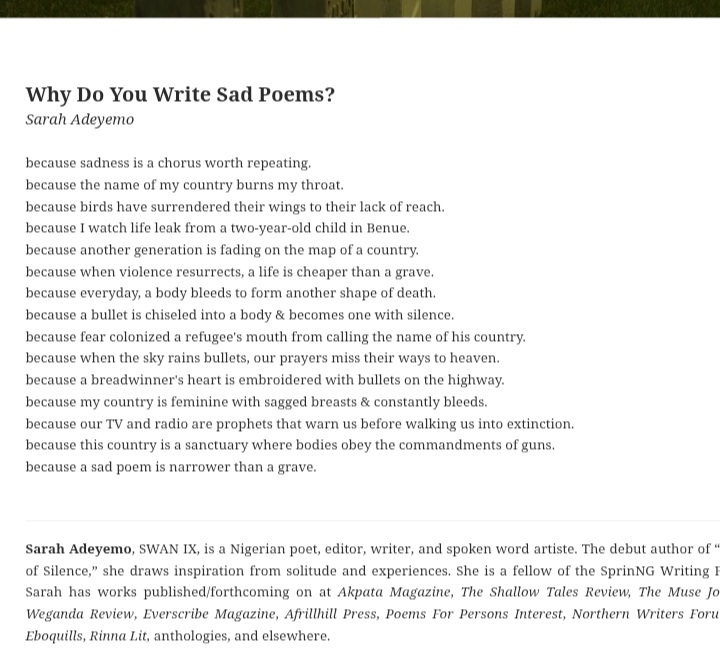
Sarah Adeyemo’s “Why Do You Write Sad Poems?” is a short, direct, repetitive, and deeply committed poem that speaks about real suffering and the several issues in our country, Nigeria. It builds into the activist committed poetry that traditional African literature is known for. The poem is powered through the repeated use of “because”, which builds on a list of sad reasons that cannot be ignored, issues that anyone familiar with the various evils happening in Nigeria will know.
What stands out most is how the poem refuses to look away. It draws attention to violence, loss, and fear in everyday life, especially within Nigeria. The images, creative as they are, are not different from what the news shows us each day: bullets, silence, bleeding bodies, and they make it clear that sadness here is a response to lived reality.
The poem talks of how hard it is to talk, how it burns the throat and even people have stopped aspiring to great things because they have lost hope. The poet notes, ‘birds have surrendered their wings to their lack of reach.’ There is violence everywhere and the country is now ‘a sanctuary where bodies obey the commandments of guns/because a sad poem is narrower than a grave.’
One of the strongest lines in the poem is: ‘because my country is feminine with sagged breasts & constantly bleeds.’ This line speaks to Nigeria as a mother, who has nourished her people. They have taken from her, grown from her, and depended on her care for so long that she now appears worn and weakened. This image of a mother whose body is exhausted, even sagging from giving so much, is difficult but meaningful. And yet, this mother is also wounded. She is bleeding, and it is hard to deny this when violence continues daily. Just recently, events in Jos reminded us of how close and real this suffering is. There was the trending video of a middle-aged mother holding her bloody son, weeping, and refusing to accept the reality that he is gone. This is the daily reality of a lot of our country folk. And it is moments like that make this poem’s sadness feel justified rather than exaggerated.
In this way, Adeyemo’s poem aligns with activist literature by turning emotion into a form of resistance. It insists that sadness and distress, as opposed to celebration, gives evidence, creates awareness. One has to only think of a poem like the haunting ‘Nightfall in Soweto’ by Oswald Mtshali to see the literary tradition that this poem falls into. There are several others that you can pick from Dennis Brutus, Chinua Achebe, Hyginus Ekwuazi, Servio Gbadamosi, to mention a few. In the end, this stark poem does not offer solutions but demands that we recognise the cost of silence. It speaks to the evils happening in country and reminds us to keep speaking in every way. In the end this is where its commitment lies: in refusing to let pain go unnoticed.

 SEVHAGE [MIDLAND] Reviews