Distinguished ladies and gentlemen, friends of literature, seekers of truth, and lovers of a gripping story well told, good afternoon. As literary critics, editors, and publishers who have had the good fortune of birthing this fine book called Hypnotising Minefield, it is our pleasure to welcome you into the extraordinary world Emeka Ukwuaba has spun in this novel. Permit us to give this warning: once you open this book, you won’t put it down. And if you lived through Nigeria’s military era, you may even start remembering things you tried to forget!
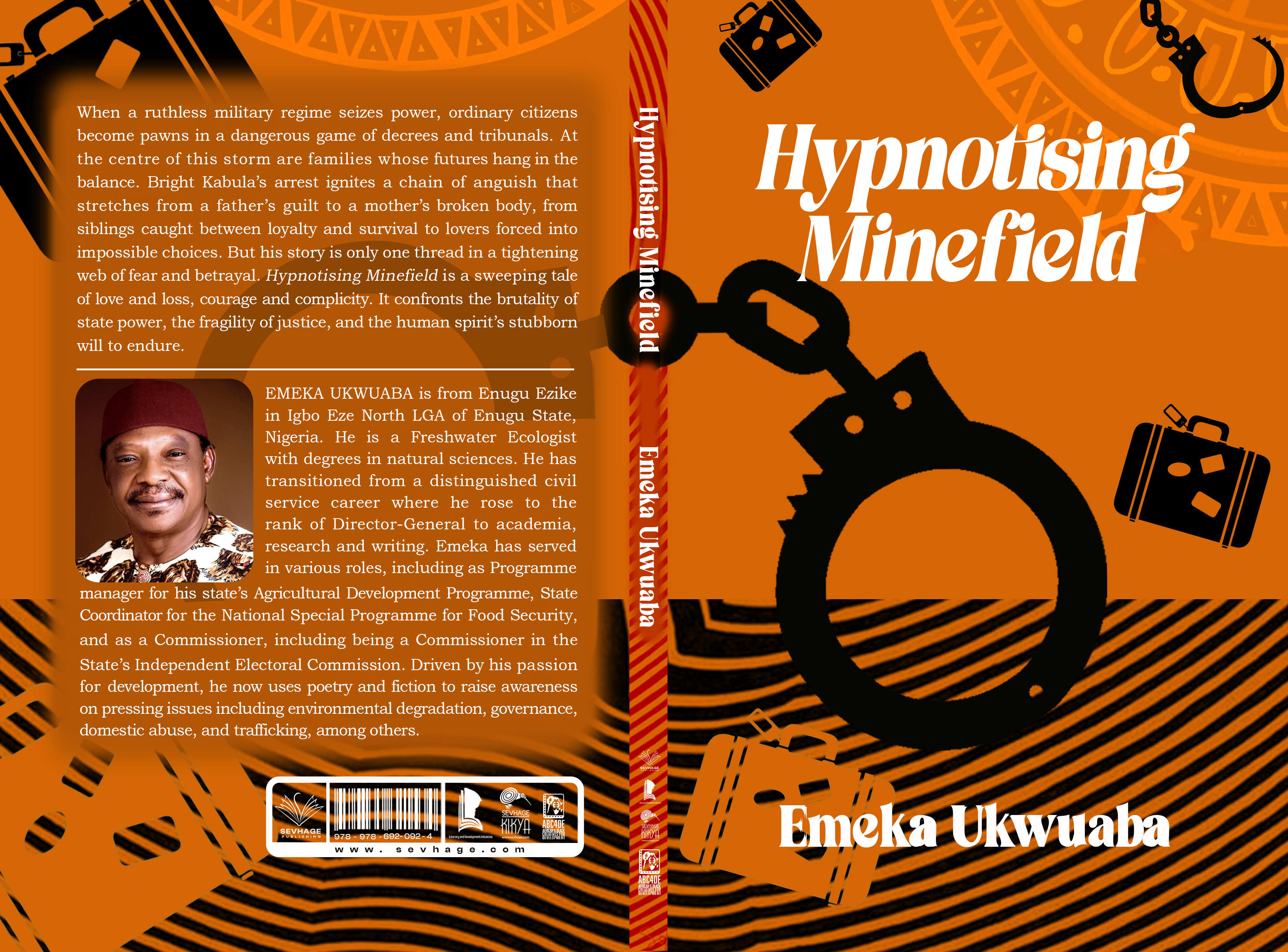
The novel is set in a place called ‘Nagiva’. My people, we all know this is Nigeria with small disguise. Same behaviour, same government style, same “surprise announcements” that used to wake the whole nation up at 2 a.m. From the very first chapter, we enter a world of military rule, retroactive laws, fear in the air, and government power that moves like thunder without warning. True talk, reading it, you’ll laugh, you’ll nod, and sometimes you’ll sigh. Because the world of this story is truly our world.
One special thing about Hypnotising Minefield is that it hides real Nigerian events inside its story. If you are sharp, you will catch them. A big example is the reference to the famous Gloria Okon drama, yes, the woman who was declared dead but rumours later said she was living in London with a new identity. You will see hints of such real-life mysteries woven cleverly into this novel. So, in a way this book is not just a story alone but a historical treasure that will help us remember. This is timely because as Achebe reminds us, referencing that famous Igbo proverb, “A man who does not know where the rain began to beat him cannot say where he dried his body.”
At this point, let us give a few details because everybody will wonder what we are talking about. The book is mainly woven around the life of a young man called Bright Kabula who is sentenced to death for drug trafficking. The way it happens is reminiscent of the military years with their draconian laws.
Bright wakes up one morning thinking his major wahala in the world is his overzealous lawyer, only to realise in a stroke of authoritarian creativity, that the government has changed laws overnight to his fatal detriment. In Nigeria, we say “problem no dey finish.” Ukwuaba goes further to show that “problem fit even borrow wings.”
Yet the novel does more than showcase individual tragedy. It mirrors the unsettling rhythm of contemporary Nigeria, where one wakes up each day surprised, as if the news headlines are being written by a novelist with a flair for plot twists. Today, it is retroactive decrees; tomorrow, it is a new regulation that contradicts the previous contradiction.
The book looks at many other things that explore the darker corners of society. As hinted here, we see drug trafficking, cultism on campuses, prostitution, codeine and tramadol abuse, and how all these things connect and feed one another. In the book, you see that crime is never far from poverty, and poverty is never far from corruption. It’s like a chain. When one link pulls, the others move. Ukwuaba shows this in a simple way that anybody can understand. And he also shows how ordinary families suffer when these crimes enter their lives.
It is a book that will leave you thinking and thinking really hard while laughing in many instances too. So to say, Hypnotising Minefield is a book that truly shows that Nigerians always find small laughter in the middle of wahala. It isn’t for nothing that we were once named the world’s happiest people. Or as Fela would put it, people who suffer and smile. It is our way of living, and we find a way to infuse it into things to help us learn more and fight depression. The novel recognises that survival in this land often requires equal doses of sense and nonsense.
One of the funniest part of the book is a scene after a public execution where a bu bus conductor is hiding Indian hemp in his pocket while quoting Bible verses at the same time. Aside the funny way the scene unfolds, we see the hypocrisy apparent in most parts of our country. My people, true talk, that is Nigeria for you. Or as the novel puts it, that is Nagiva for you. Ukwuaba’s humour makes the heavy issues of the book easier to swallow. He also tries to ensure that his work is lively and filled with measures of suspense so you are engaged throughout.
This book also teaches something very important: Quick money is dangerous. It also reminds us that we are strong people who refuse to give up.
In this story, the people who look for fast cash end up paying a heavy price, sometimes even with their lives. The author shows that slow success may be hard, but it is safe, and achievable. And in today’s Nigeria, safe progress is wisdom.
Hard work still works. Good character still matters. The book encourages young people, and indeed all of us, to avoid shortcuts. As the saying goes, some times short cut is the longest route.
What Ukwuaba accomplishes in this book is beyond mere realism. He weaves these events with a sensitivity that lays bare the human cost. We watch Bright’s family disintegrate and rebuild in the shadow of loss. We encounter Merimba, carrying a child conceived in love but born in grief. We see the ripple effect of institutional violence on the ordinary citizen, on mothers who pray themselves into illness, on siblings thrust into premature adulthood, on communities oscillating between hope and fear.
But perhaps the greatest strength of Hypnotising Minefield is its moral and emotional clarity. The book forces us to sit with uncomfortable questions:
- What does justice mean in a society that keeps moving the goalposts?
- Who gets to live or die when the state takes justice into its own hands?
- How much of our national tragedy is born not of wickedness alone, but of the long silence of good people?
The novel does not claim to offer easy answers, after all, even the title warns us that the journey before us is fraught with peril. Yet it offers something even more valuable: a mirror. It gives us a chance to see ourselves, our country, our anxieties, our contradictions, staring back at us with unflinching honesty.
We, as the publishers, are proud of this book not only because of its literary merit, of which there is plenty, but because it takes the bold step of humanising an issue often reduced to headlines, police briefings, and moralistic lectures. In a world where drug trafficking, addiction, and criminalisation continue to destroy families from Makurdi to Enugu, from Lagos to London, Ukwuaba’s work reminds us that behind every statistic lies a story. Behind every condemned person is a constellation of mothers, fathers, siblings, lovers, and unborn children who carry the burden long after the headlines fade.
In short, Hypnotising Minefield is a necessary intervention for our time that is worthy of applause.
If you read Ukwuaba’s earlier book Benign Pain, which exposed the suffering of housemaids in Nigeria, you will know that this author cares deeply about society. He uses stories to show the truth and make us think. With Hypnotising Minefield, he continues that mission, but on an even bigger scale. He writes like someone who wants Nigeria to do better. He writes like someone who wants young people to learn from the past.
For these and much more, to Emeka Ukwuaba, we say: thank you for gifting us a novel that is courageous, evocative, richly layered, and profoundly human. To everyone gathered here, we say: prepare yourselves. You are about to enter a story that will not leave you unchanged. Hypnotising Minefield is exciting. It is emotional. It is funny in the right places. It is serious where it needs to be. And most importantly, it is our story, told honestly and with great skill. If you want entertainment, this book will give you. If you want history, it is there. If you want life lessons, the book is full of them. If you want gist, drama, scandal, campus life, politics, family troubles, everything is inside.
Ladies and gentlemen, Hypnotising Minefield is a book you must read. It is a gift to this generation and a warning to the next.
Thank you.
S. Su’eddie Vershima Agema is a multiple award-winning writer, critic, and former Chairman of the Association of Nigerian Authors (Benue State Chapter)
Oko Owoicho, poet and theatre director, is the Programmes Manager at SEVHAGE and Creative Director of Abuja Poetry Troupe.

 SEVHAGE [MIDLAND] Reviews