What is your background story with writing? What prompted you in the field, and what has the experience been like?
In the mid-90s, as a teenager, I started out wanting to become a rapper, which also involved story-telling, if you want your songs to be impactful. Meanwhile, I can’t remember how or where I got my first copy of Hints magazine in those days, but from that moment onward, I kept looking out for Hints and devoured the contents. As the days went by, I also began writing stories similar to those I read in Hints.
After a while, when Nollywood movies started coming and gradually gaining popularity, I started trying my hands at writing stories which I thought were for the screen until one day I went to the then Lenscope Media at Dogon Karke, Jos, to see Sanni Muazu. I showed him my manuscript for film, but he gave me a most depressing response at that time—he only glanced at it and said, “Young man, leave this thing you’re trying to do and focus on your school.” Well, I left Lenscope Media that day devastated and thought that I should never try to write any story again. I decided to focus on writing my rap songs only.
But soon, I realized I could not completely stop writing stories. I would write and burn the papers and write and burn and write and burn, feeling depressed all along because I kept worrying about whether what I was writing made any sense at all.
When I went to Kaduna Polytechnic to study Mass Communication, I got introduced to script writing. From then on I began spending long hours at the national library, Kaduna, studying various books about script writing. That gave me some confidence, knowing the format that scripts were written for the screen.
Thankfully, just after graduating from Kadpoly in 2006, I wrote a 26 episode script purchased by Akeem Sani, a Kaduna based TV drama series producer and he paid me N91,000 for it in 2009. That was after he made me work on the script for like 3 years! I can’t even remember the number of rewrites I did (laughs). Then I thought it was quite frustrating.
I kept writing screenplays throughout my days in NTA from 2009 to 2016, when I resigned, confident enough to pursue independent writing and film production.
In 2017, I was contracted by the National Association of Nigerian Nurses and Midwives to script a 13 episode drama series and got paid in 7 figures. That was encouraging, and it strengthened my resolve to make something out of my writings.
In 2017, again I tried my hand at short stories and had one of my early short stories, ‘Creating our gods’ published by the Kalahari Review. It was a significant victory for me because I explored certain part of my culture and tradition and shared that with the world and it also made me realize I could actually do well at different writing—screenplays, short stories and novels.
After that first publication, I made a couple of more short story publications on Kalahari Review again, then Shallow Tales Review, ThisIsAbuja, The Aayo Magazine and KUFENA, respectively. Over a dozen of my articles were also published by the Niche, an online magazine based in Lagos.
Now here we are, with Beautiful Thief & Other Stories, a collection of short stories as my debut which earns me the legitimacy of calling myself a writer!
Some journey you have had there, well done. Now that we are on the topic of your collection of thirteen short stories, The Beautiful Thief, what was the inspiration behind the book, and how long did it take you to put it together?
The book is inspired by various life circumstances I have observed and my frustrations with certain issues. It is also inspired by my desire to explore these characters that jump into my head and insist that I must share their stories. It took me about five years to put it together. But that’s partly because of procrastination (laughs) and attending to many other things concurrently.
You are known as a cultural activist for your people, the Gbagyi people of Abuja and other parts of central Nigeria. How does this work out in your professional life, and how does it play into your art?
Wow, I just heard this for the first time from you, describing me as a cultural activist. I fancy that, but I have never thought of myself in that light. I am just challenged that such beautiful people with so rich a culture and tradition hardly have any literary work that immortalizes and, or showcases them to the world; neither is there any strong artistic piece aimed at celebrating their beautiful and rich heritage, apart from an attempt by one of our revered musicians, Bez Idakula. Since God has deposited these gifts in me, I felt I had better do some of those things that I wish others who have gone before us had done—creating art pieces that will inspire several other generations coming after us.
This desire runs through my professional blood because I tap into it over everything I do professionally.
Apart from my literary work, I have been working on a documentary series with some friends. And we have been on that project in the last 4 years even though we have been on an extended break since June last year or thereabout.
Which story would you say gave you the most challenge in writing and what is the story of the challenge?
The story that gave me the most challenge in the collection is ‘Boys Can Be Broken Too’ because I wanted it to be really short, and I had a strong and urgent feeling about the message I wanted to pass through it. You know, such stories might end up coming out too mechanical because the writer was interfering by trying to control the form and structure of such a story.
My two editors had some issues with that story, but I insisted on putting it in the collection. And there you have it…
Your story, ‘Withered Roses’, looks at domestic issues, marriage and sacrifice. What is the thinking behind the story, and how does this connect to contemporary happenings?
Marriage is an incredibly beautiful thing and I don’t think there is any other institution in the world that suffers satanic attack like marriage. And it is no surprise because if marriages are in great shape as God intended them to be, the devil can hardly have his merchants on the earth or in our societies.
‘Withered Roses’ connects to contemporary happenings in the sense that a very tiny thing—something as fleeting as misunderstanding can destroy a marriage that has been built over years of commitment, love and sacrifice if the people involved are not careful enough. The story also reminds us about the power of words—how they can build and also easily destroy.
Indeed. On a similar note, it is evident that your writing shows you as a socially committed writer following traditional African writers. What informed this writing style and your general view on the role of writers in contemporary society?
It is difficult for me to imagine writing that does not attempt some commitment to the society to correct the wrongs, inspiring people to do what is right and even challenging them to be heroic.
Writing plays a critical role because without it, there can’t be reading. And without reading, there is no developing the brain for all the artistic, scientific and technological exploits that man has been doing over the years. Writers shape our thinking and even refine it. Writers are the privileged fibers of every civilization and human advancement.
What is your aspiration for your work, and what other literary project do you have coming up?
Aspiration for my work is that it permeates into every nook and cranny of this world and that it has a positive impact on my readers and inspires other writers, especially from my clan. I have many more short stories than those that have made it into this collection. This means you should expect another collection of short stories from me towards the end of next year by God’s grace.
Meanwhile, I will rewrite a screenplay I wrote 6 years ago meant for a 26 episode drama series and another for a feature film. Then, of course, I am working on Creating our gods. I am trying to develop it into a historical novel where I have the opportunity to really explore the beautiful culture and tradition of the Gbagyi people of Nigeria.
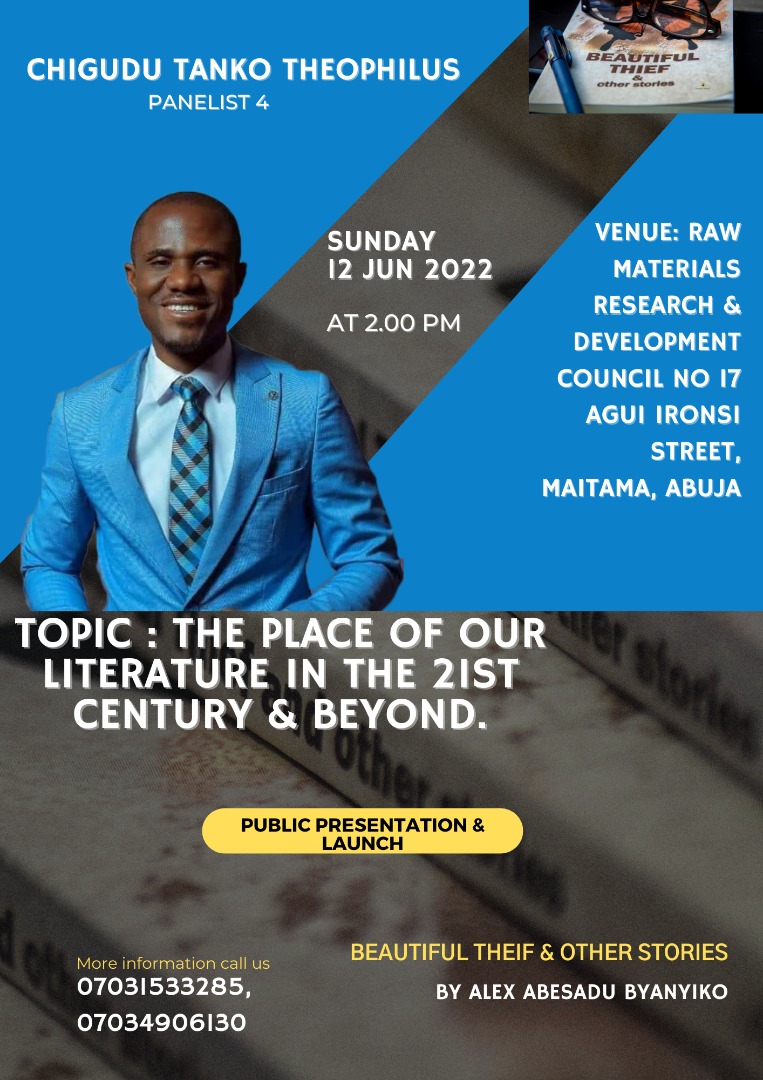
The Beautiful Thief is set to be launched on Sunday 12th June 2022 at the Raw Materials Research and Development Council, 17 Aguiyi Ironsi Street, Maitama, Abuja

 SEVHAGE [MIDLAND] Reviews
Expository read.
Thank you.