Title: Mada Religion and Society
Author: Amin Zaigi Ngharen
Publisher: SEVHAGE Publishers
Year of Publication: 2018
Genre: Historical Prose
No. of Pages: 164
Reviewer: Eugene Yakubu
Mada Religion and Society covers an ethnographic and sociological history of the Mada tribe of Central Nigeria, particularly found in Nasarawa, Kaduna and the Federal Capital Territory. Ngharen reconstructs decades of history that cover the origin, customs, mythology, religion and politics of the Mada tribe. And what makes this piece interesting is that it is written by an insider who has extensive and comprehensive knowledge of the mores and culture of the Mada tribe, hence the accurate and insightful details.
A historical and sociological study of ancient African tribes and traditions is timely and worthwhile, what would have been swept under the rug if researchers and writers don’t go a step further to reconstruct past histories and study societies and cultures. Ngharen uncovers the Mada history at its pre-colonial, colonial and post-colonial phases and makes sure he captures the contemporary society in its epochal transformation and relating it to past customs and cultures which get to show the effects that westernization and civilization had on African cultures and traditions. Meanwhile, unlike some typical African cultures, the Mada tribe has been faithful enough to its roots and historical antecedents as proven by the author. Even though the undaunting presence of the Abrahamic religions seems pertinent, tradition of rituals and fetishism, traditional religions seems to linger around the people till date. Nonetheless, a traditional religion which believes in the supremacy of the supreme God referred to as “Mkparu” who formed the universe and oversees “a host of secondary divinities”.
The Mada tribe has its own unique origin stories, which like of other tribes could be unproven but archaeological evidences which Ngharen refers to as “fragmentary evidences”, oral and anthropological sources confirmed their facticity. There might have been cultural contacts too between the Mada and their neighboring tribes especially in Central Nigeria which shows in the similarity in local dialects and words. Ngharen does an ethno-linguistic examination of these words, their origins, their similarities with other words and points of disparity as well as a detailed migratory history of these tribes which proves a certain contact in the past.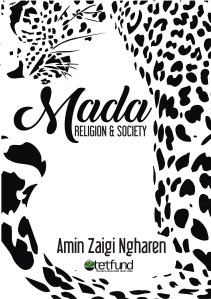
According to the author, the Mada tribe had a working political and administrative system even before colonization. There were organized structures from the family, the village or community, the clan, and the cin cin (mythical lineage) and all these structures contribute in managing the affairs of the people at various levels. Ngharen proves that the communities were administered by a council of elders known as “Ban Lanku”. This reiterates the argument that African was not as savage and crude as the colonialists vehemently tagged it. There has always been a system of leadership which the people all respected and adhered to. Mada Religion and Society has interesting and insightful arguments that would reconstruct Africa’s bleak history and deconstruct the jaundiced view by European’s of schooling Africa in civility. For the author, the Mada tribe has a religion that works for them and fits their livelihood more than the religion introduced by the Europeans.
What Ngharen does in this book is to examine Africa through a microcosm of the Mada tribe, thereby analyzing larger issues of religion and society in traditional and contemporary societies. The book contains adequate ethnological information with well-researched views on vital topics. The author captures wholesomely the social, religious, physical and even emotional characteristics of the Mada tribe, thus permit me if I say this is, among the many, one of the most important book about the Mada tribe and interestingly written by an insider also. Graphic illustrations of relevant sites have been offered here and there in the book which nonetheless proves the author’s painstaking effort to capture in detail every bit and pieces of history of a significant tribe in Nigeria which would have been swept in the shores of time if erudite researchers like Ngharen hadn’t taken the effort to reconstruct this interesting history of a culture and people which is struggling to stand tall despite the so many jibe thrown at her by civilization, globalization and time. This is a wonderful book and I’ll recommend it to students of history, religion, and even sociology and anthropology. It has adventurous tales and stories that may sound stranger than fiction but nonetheless real. It makes you want to go out looking for this tribe wherever they may be in Nigeria, and gladly, the author offers a geographical guide to where to discover this tribe.
Mada Religion and Society will tell you something about the society and Africa using the Mada tribe as a point of reference but not confined to its culture and history alone. It is reinventing tradition and culture amidst the threat of oblivion in the contemporary world.
For copies of the book or to get in touch with the author, you can send a mail to sevhage@gmail.com

 SEVHAGE [MIDLAND] Reviews
You have done noble , but I need more light on this, more about mada before colonization